

-
-
-
-
Technical Services
-
Video picture
03
2020
-
08
Swiss scientists new technology: make concrete lighter and more environmentally friendly
Scientists around the world are looking to adapt production processes to make them more environmentally friendly, and now scientists have found a new prestressing technology that makes concrete lighter without sacrificing strength and also reduces carbon emissions.
As the most commonly used building material in the world, the carbon footprint of concrete is huge, and the billions of tons of concrete produced every year require a lot of energy. To this end, scientists around the world are looking to adjust production processes to make them more environmentally friendly, and even small improvements can have a big impact. But now scientists have found a new prestressing (pre-stressing) technology that makes concrete lighter without sacrificing strength and also reduces carbon emissions.
The research team of the Swiss Federal Laboratory for Materials Science and Technology (EMPA) has found a new breakthrough and developed a special formula for CFRP-reinforced concrete to expand when it hardens. This means that there is no need to anchor and stretch the steel, as the material expands itself as it hardens. The tendon will remain in this state permanently, exerting a counter force on the concrete, creating a compressive stress.
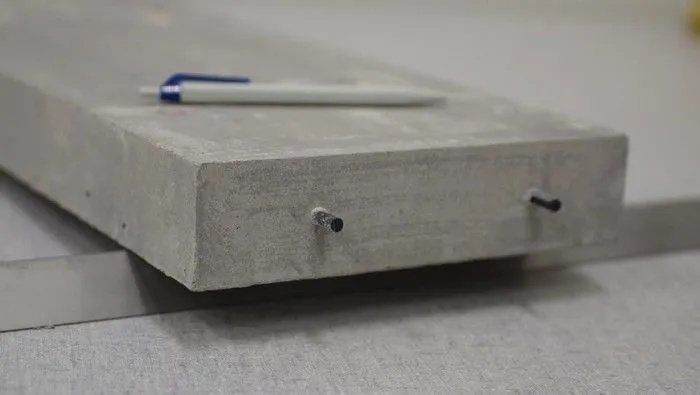
Dr. Mateusz Wyrzykowski, a member of the project, said: "If you want to prestress these CFRP reinforcements in order to be able to build thinner structures with higher load-bearing capacity, you will reach your limit. This is like a person wrapping a rubber band around his arm and trying to stretch them. The rubber band will be in a state of tension, and a person's arm will experience the compression of the rubber band. According to the analogy, such a mechanism will make the expanded concrete experience compression."
This opens the door to leaner concrete elements that provide tremendous strength, and the team's tests show that the self-stressing material can withstand loads comparable to traditional prestressed concrete and about three times higher than non-prestressed CFRP concrete elements.
"Our technology opens up entirely new possibilities for lightweight construction," Wyrzykowski said. "Not only can we build a more stable structure, we can also greatly reduce the amount of material used. We can easily prestress in several directions at the same time, such as for thin concrete slabs or prismatic curved concrete shells."
Concrete
No.25, Fulian Road, Fu'an Industrial Zone, Foshan City
No. 7, Jianyi Road, Xinjiang Wujiaqu Industrial Zone, Bingtuan New Building Materials Industrial Park
12 Potsdam Avenue, Berlin, Germany
WeChat Public Number
TikTok
Copyright©2014-2025 Guangzhou Hengde building materials Co. Ltd.